



Ion exchange resin tartaric stabilization is used in the food & beverage industry to reduce tartrate crystallization and precipitation (e.g., potassium bitartrate and calcium tartrate) in juices, grape juice, musts and wines. The process selectively removes the cations that drive precipitation-mainly potassium (K+) and calcium (Ca2+)-and may provide controlled acidification through hydrogen ion (H+) release.
Tartaric stabilization plants
Ion exchange resin plants for tartaric stabilization of juices, musts and wines
Process overview
Tartrate precipitation is a result of crystal formation caused by the supersaturation of tartaric salts. It can occur after pressing/crushing and intensify during storage, cooling, or concentration changes. Besides visual defects, it can critically affect industrial operations.
Engineering and automation
The resin system operates in a controlled cyclical mode. Service runs until resin is exhausted, then automatic regeneration follows using a suitable regenerant. The presence of a PLC with HMI facilitates management of recipes and cycle parameters, enhancing traceability and efficient operation.
Key advantages
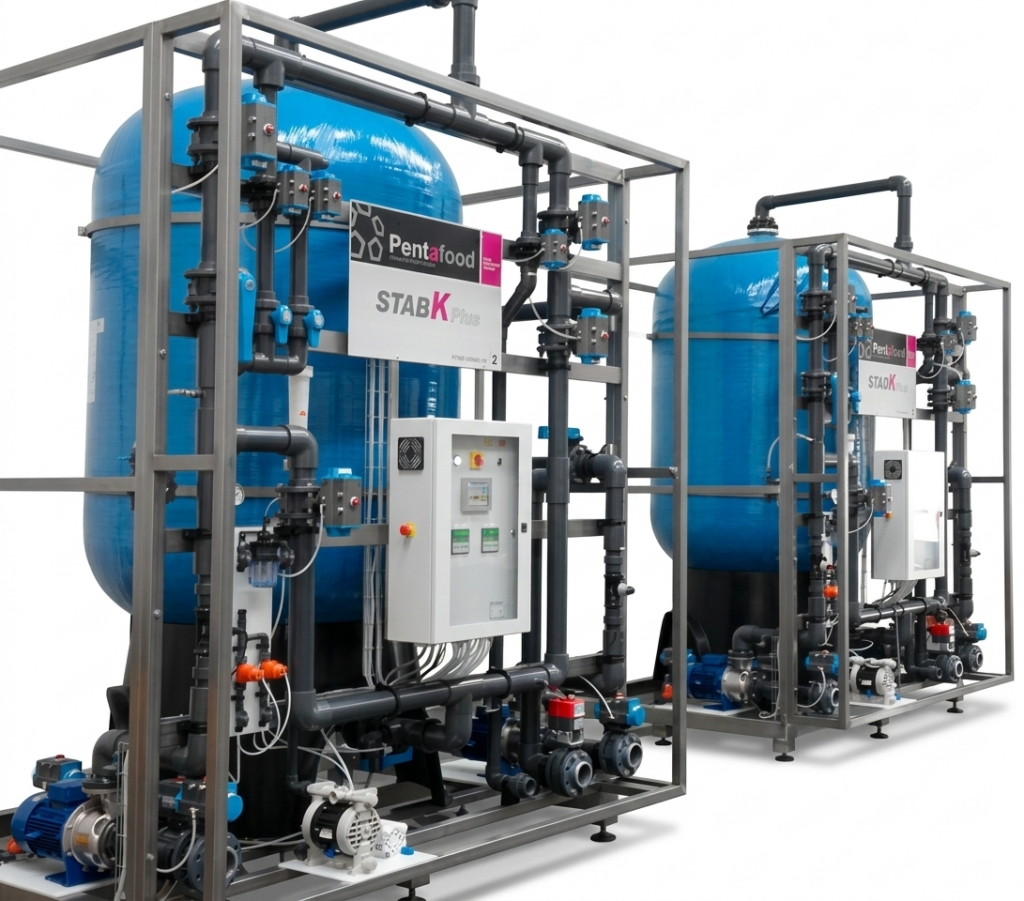
Technical configuration
The system employs columns filled with food-grade cation exchange resin that captures both K+ and Ca2+ ions, releasing hydrogen ions to aid in preventing tartrate salt formation. This process helps achieve enhanced stabilization.
Mounted on a self-supporting skid, the plant is engineered for hygienic and precise operation, featuring pneumatically actuated valves and integrated support circuits to ensure efficient performance and longevity.
Sizing inputs
- Product type such as juice, grape juice, must, wine and desired stability.
- Initial K+ and Ca2+ concentrations.
- Flow rate and daily processing volumes.
- Impact of pH and acidity changes on the profile.
- Filtration levels and colloidal influence from upstream.
In specific scenarios, treating only a portion (5–30%) and subsequently blending is adequate to achieve desired stability with limited alterations to pH.
FAQ
It is a treatment that reduces tartrate crystal formation by selectively removing the cations that promote precipitation, mainly potassium (K+) and calcium (Ca2+).
Because concentration increases supersaturation and crystallization. Reducing K+ and Ca2+ upstream limits exchanger deposits, improves heat transfer and reduces cleaning shutdowns.
Not necessarily. Often a fraction (typically 5–30%) is treated and blended back to achieve overall stability while limiting process time and product impact.
It can lower pH in the treated fraction due to H+ release. Targets and stop points are set and blending is used to reach the final product specification.