



Plants designed for metal removal from juices and food solutions ensure that undesirable contaminants such as iron, copper, and lead are effectively extracted. This process enhances the overall quality and stability of the product, making it suitable for strict compliance with food safety standards.
Metal removal from food-grade solutions plants
Process overview
In typical processing, unwanted metals can leach into food liquids, impacting their quality. The use of selective resin beds allows for the targeted removal of these contaminants without altering the organoleptic properties of the product, thus maintaining its desirable characteristics throughout the process.
Engineering and automation
Our plants function automatically during both the service and regeneration phases. The system incorporates robust engineering designed for maximum uptime as well as reliability, allowing for uninterrupted operation within a production line. Advanced control via PLC systems ensures accurate monitoring of process parameters for optimal results.
Key advantages
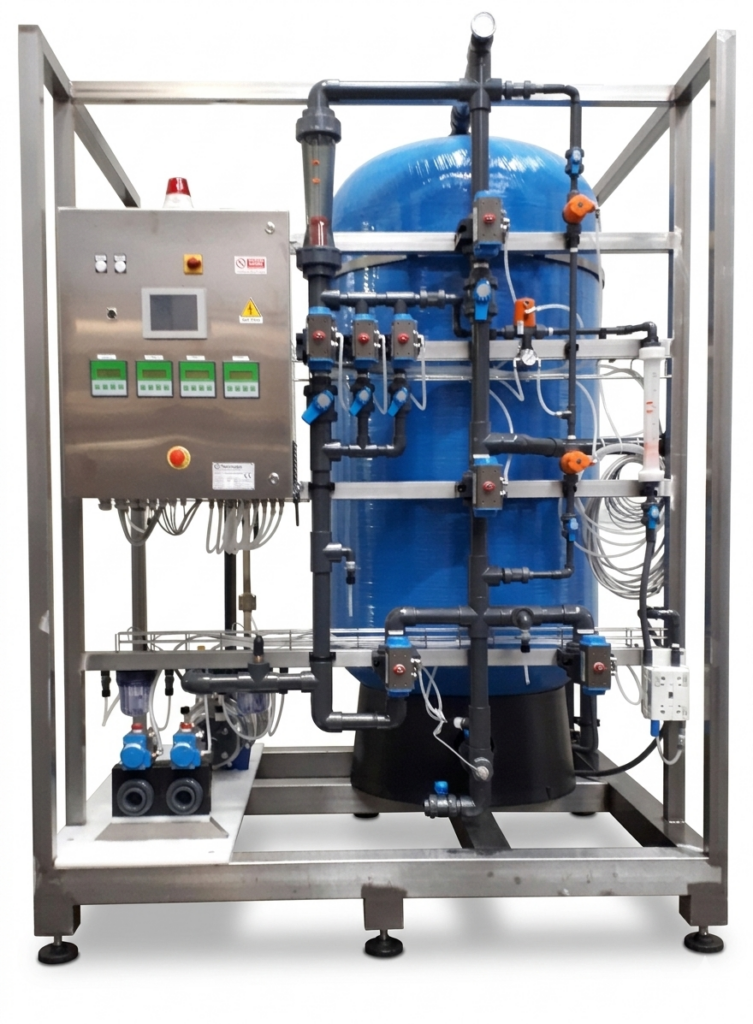
Technical configuration
The solution flows through columns packed with a cation exchange resin that selectively captures undesirable cations like iron, copper, and lead. This exchange not only enhances product safety but also provides long-term stability and product quality.
The plant structure is robust, utilizing stainless steel to uphold hygiene and durability standards. Additionally, intelligent control systems facilitate the monitoring of flow rates and resin conditions, ensuring optimal operational performance.
Sizing inputs
- Type of food liquid being processed.
- Desired quality standard and batch targets.
- Flow rates across different operating cycles.
- Trace impurity levels and related specifications.
- Upstream treatment processes in place.
Typically, addressing only a portion of the volume at selective intervals can be sufficient for maintaining overall quality while minimizing operational costs.
FAQ
Typical configurations remove iron and copper and, when required, lead. Depending on the matrix and product targets, dedicated solutions can be evaluated for other trace metals.
The process is designed to be selective for metals, keeping the product’s organoleptic properties as unchanged as possible.
Even at trace levels, iron and copper can affect stability and perceived quality by promoting oxidative reactions. Demetalization supports more stable, repeatable product.
Regeneration is automatic and uses an acid reagent (H₂SO₄ or alternatively HCl). In this step the resin releases captured metals and its capacity is restored.