



Anthocyanins and flavonoids extraction systems utilize packed columns containing food‑grade adsorbent resins aimed at selectively capturing polyphenolic compounds from grape must or juice. This innovative technology facilitates controlled decolorization, allowing producers to create a standardized product while recovering high-quality color concentrates suitable for food and beverage applications.
Anthocyanins and flavonoids extraction and recovery systems
Process overview
During the extraction process, anthocyanins and flavonoids are effectively isolated by using specially designed adsorbent columns. This method balances color recovery with the preservation of essential product characteristics, delivering a high-quality output.
Engineering and automation
Our systems operate through automated cycles defined by a PLC-controlled process, which optimizes resin service and regeneration phases. Innovations in engineering ensure consistent performance while reducing operator intervention for enhanced reliability and efficiency.
Key advantages
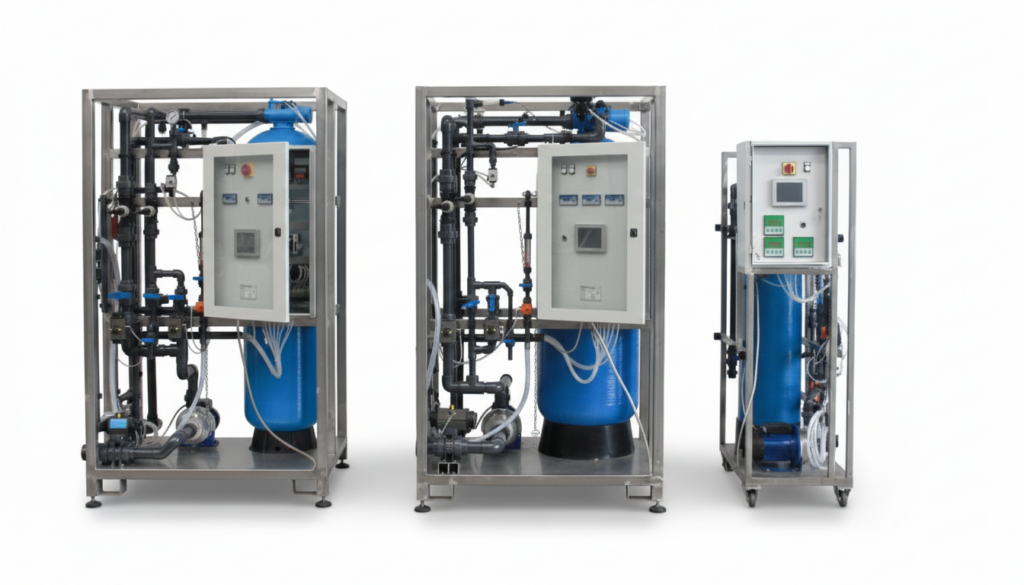
Technical configuration
The extraction system involves multiple columns packed with adsorbent resin that efficiently captures red grape pigments and other target compounds. Key performance is achieved by manipulating flow rates and cycle parameters, optimizing both product quality and output volume.
The setup consists of stainless-steel components that ensure long-lasting durability and hygienic operation, accompanied by automated flow management for optimal processing.
Sizing inputs
- Feed matrix (grape must/juice), turbidity, and filtration levels.
- Initial anthocyanin concentration and desired decolorization targets.
- Flow rate required and campaign duration considerations.
- Variable quality characteristics among grape batches.
- Preferred recovery method (hydroalcoholic or alkaline) and safety requirements.
Often, processing 10 to 30 percent of the total must for blending achieves the desired color and quality while maintaining production efficiency.
FAQ
Anthocyanins are a specific class within flavonoids (polyphenols) and are among the main contributors to red/purple colour in grapes.
It performs controlled decolorization of must or grape juice and recovers a dedicated colour concentrate stream rich in anthocyanins/polyphenols/flavonoids.
To remove solids and colloids that would quickly saturate the resin bed and cause fouling, improving uptime and repeatability.
A single column suits compact lines and limited campaigns; three columns in series increase capacity and stability, especially with variable matrices.
It helps obtain a more concentrated and cleaner colour stream, improving valorization of recovered compounds.
Hydroalcoholic elution desorbs colour into an alcohol‑water stream (often compatible with solvent recovery). Caustic regeneration desorbs colour under alkaline conditions. Choice depends on purity, safety and effluent handling.
The system is designed to mainly remove colour compounds, aiming to preserve other characteristics as much as possible; verification is done through product trials.
Yes. PLC‑controlled recipes manage service, regeneration and colour recovery sequences, supporting traceability and standardization.