



Chemical storage systems in food processing plants are engineered to ensure safe containment and management of liquid reagents. These systems, when integrated with resin-based technologies, facilitate consistent availability and precise automation of chemical processes crucial for production efficiency.
Chemical product storage plants
Process overview
Chemical storage and dosing systems draw reagents from storage tanks, proportionally distributing them based on preset parameters and resin volumes. This ensures a continuous and efficient process, minimizing manual intervention and operational mishaps.
Engineering and automation
Storage systems involve PLC automation with safety interlocks and level controls, offering reliable operation. Tanks are made from HDPE for robust chemical resistance. The design caters to plant integration, supporting both safety and efficiency.
Key advantages
Technical configuration
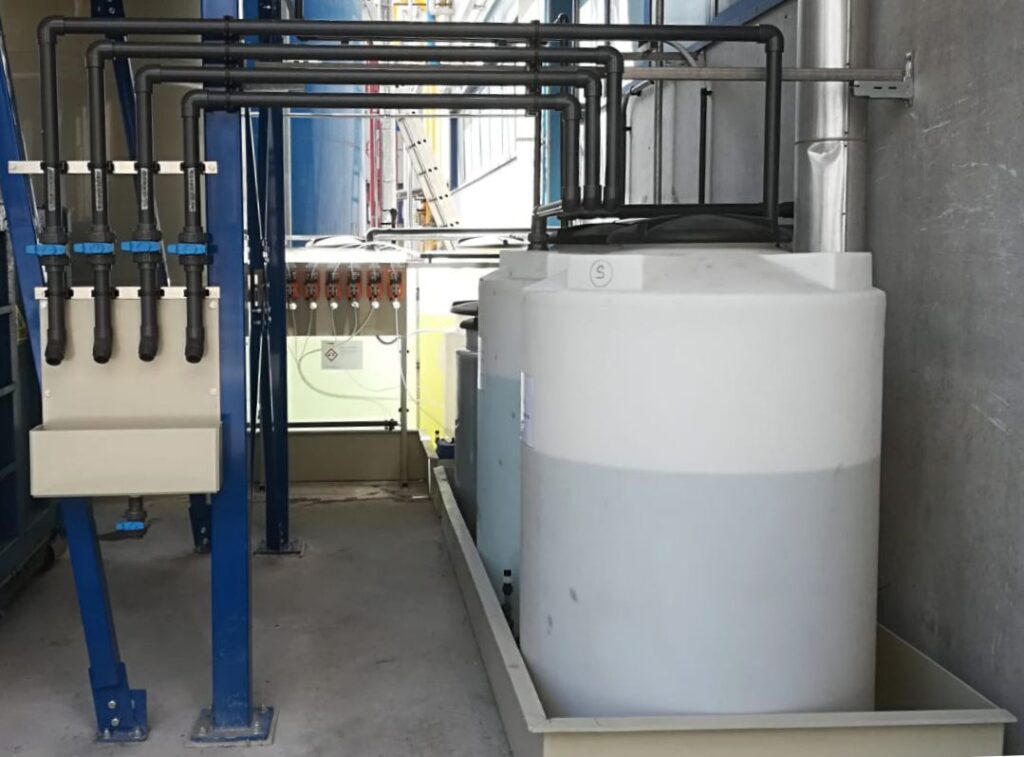
Chemical storage configurations vary according to the application and plant size. The use of HDPE tanks with flat-bottom construction is selected for chemical resilience and ease of maintenance. Level controls and PLC systems automate the management of reagent supplies and safety protocols, ensuring a smooth operation.
These systems are typically integrated on self-supporting frames that house all necessary connections, pumps, and control units for straightforward deployment in various industrial settings.
Sizing inputs
I am text block. Click edit button to change this text. Lorem ipsum dolor sit amet, consectetur adipiscing elit. Ut elit tellus, luctus nec ullamcorper mattis, pulvinar dapibus leo.
FAQ
Flat-bottom HDPE tanks produced by rotational molding are widely used, thanks to chemical resistance and self-supporting construction.
Reagents are suctioned at defined ratios and for preset times; PLC logic manages dosing based on resin volume and regeneration recipe.
Yes. With PLC and level sensors, alarms, safety interlocks, and pump/valve commands can be implemented for safer, repeatable operation.
Sizing is based on consumption and downstream plant size. Storage is often designed for about 5–30 complete regenerations to reduce refilling frequency.