
Design of Food Grade Resin Plants

Food & Wine applications — tailored, trial-based engineering for measurable results.

Pentafood designs food-grade resin plants for the food industry and wine-related applications, delivering tailored solutions to solve process issues and improve the chemical and sensory profile of the final product.

Engineering starts from a detailed review of the production workflow and results in a functional, repeatable, easy-to-run skid, sized on design values and supported by trials on the real product.
What it is

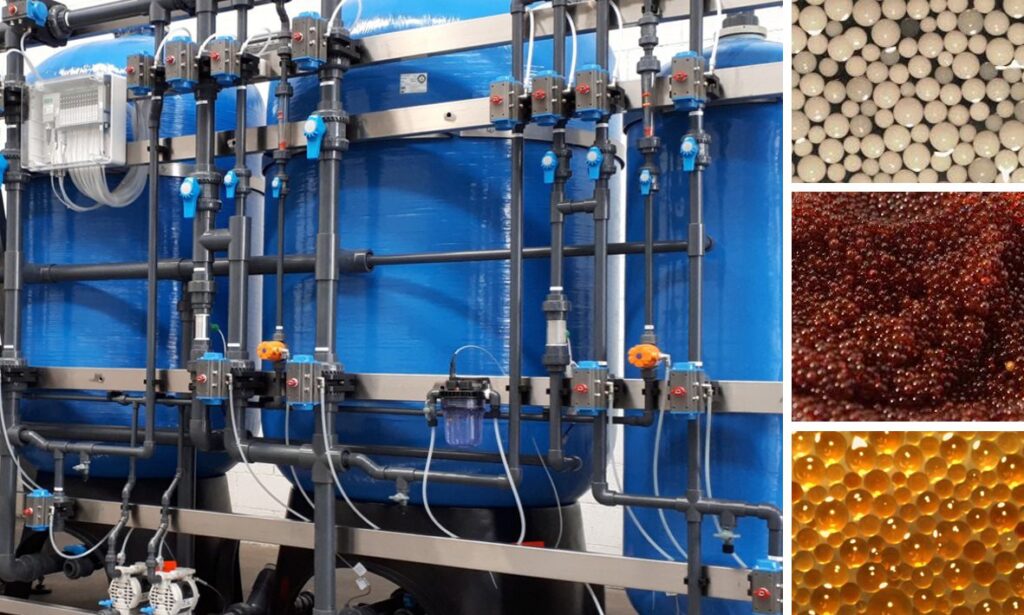
A food-grade resin plant uses one or more columns filled with food-grade resins (ion exchange or adsorbent media).

The product flows through the resin bed enabling selective removal or recovery (ions, metals, color, bitterness, oxidized notes, or valuable fractions). Regeneration restores capacity for stable cycles.

Typical targets

  • Polishing & controlled corrections (demineralization, selective ion reduction, stability).
  • Wine stability & clarity (e.g., K/Ca or trace metals management).
  • Color/bitterness & off-flavour reduction (stop-point + acceptance criteria).
  • Residues reduction (selected contaminants with validation aligned to the matrix).

Key design factors

  • Resin selection (selectivity, capacity, kinetics, compatibility).
  • Sizing (flow rate, contact time, breakthrough, regeneration frequency).
  • Regeneration & utility streams (consumptions, tanks, safety, spent routing).
  • Automation (recipes, interlocks, alarms, data logging, traceability).
  • Hygienic design (sanitary piping, dead-leg minimization, CIP-ready layouts).

Key design factors for a resin skid

Engineering defines resin choice, sizing, regeneration logic and automation to achieve repeatable cycles with measurable quality targets, while preserving yield and sensory profile.

Resin is selected for selectivity, capacity, kinetics and compatibility with pH, temperature and product composition. Potential side effects are evaluated and mitigated through prefiltration, bypass strategies and defined stop-points.

Sizing is based on flow rate, contact time, breakthrough curve and desired regeneration frequency. Columns can run in series or parallel to ensure production continuity and consistent output quality.

Engineering defines sequences, consumptions, tanks and safety for regenerants and rinses. Spent streams are collected and managed under the customer plan (recovery/neutralization/routing), already evaluated during design.

PLC/HMI manages recipes, safety interlocks, alarms and data logging (pH, conductivity, flow, temperature, pressure). Cycle traceability supports quality control and repeatability.

Skids are engineered with hygienic criteria (sanitary piping and connections, minimized dead-legs, CIP-ready layouts where needed) and food-contact suitable materials. Resin and material documentation are selected according to the customer’s applicable requirements (food-contact rules, internal procedures, audits).

Useful references

Ion exchange
Adsorption
CIP (Cleaning in Place)

Suggested inputs for sizing:
flow rate, pH/temperature, composition, target removal/recovery, sensory constraints, prefiltration, continuity, regenerant handling plan.

The Pentafood method: from trials to final engineering

Data collection & measurable goal

Definition of matrix, line constraints and a measurable goal (reductions, recoveries, quality limits and yield).

In-house lab & pilot trials

Pentafood performs product trials to select the resin and define capacity, selectivity, yield and consumptions, reducing uncertainty when scaling up to industrial size.

Detailed design & start-up

Delivery of a dedicated skid (not a generic standard), designed to minimize routine operational effort, with training and start-up/optimization support to stabilize performance and operating costs.

Why choose Pentafood

Proven know-how in resin management and engineering for food and wine applications, with a trial-based approach and solutions tailored to customer needs.

The result is a high-performing plant, easy to operate and aligned with product quality targets.

FAQ

Food applications require engineering around the real matrix and measurable targets (quality/yield), including hygienic design, chemical compatibility and control of sensory side effects. A tailored skid optimizes resin choice, cycle logic and automation for the specific process.

Typically: flow rate, product composition, operating pH and temperature, removal/recovery target, outlet quality, sensory constraints, prefiltration needs, required continuity and the intended management of regenerants.

Yes, by defining a selective target and a clear stop-point for each cycle. Sample trials and before/after analytics help select the right resin and validate that polishing does not introduce undesired effects.

Regeneration is engineered with automated sequences, dedicated tanks, controlled rinses and safety interlocks. Spent regenerants and wash waters are collected and managed under the customer plan defined during engineering.

Yes. In-house lab runs bench and pilot tests to select media and operating conditions, estimating performance, consumptions and yield to reduce scale-up risk.

Periodic checks on pressures, flows and quality indicators (e.g., conductivity), verification of valves and sensors, regenerant handling, and cleaning/rinsing per recipe. Design aims to reduce effort through automation and clear procedures.