


Rectification (also known as deionization) improves the stability of apple or pear juice by removing non-sugar components, including dissolved minerals and other ionic species. This process enhances the quality of the juice, minimizing the risk of scaling and deposits in downstream operations and ensuring a more stable product.
Apple or pear juice deionization plants
Process overview
The process uses food-grade ion-exchange resins to selectively remove ionic components, beneficial for the downstream concentration stage. This enhancement reduces the potential for scaling in evaporators, facilitating a concentrate suitable for further food processing.
Engineering and automation
Pentafood plants are programmed for 24/7 automatic operation. The PLC system optimizes wash and regeneration cycles, ensuring consistent quality, while minimizing resource consumption and downtime, resulting in a reliable and cost-effective solution.
Key advantages
Technical configuration
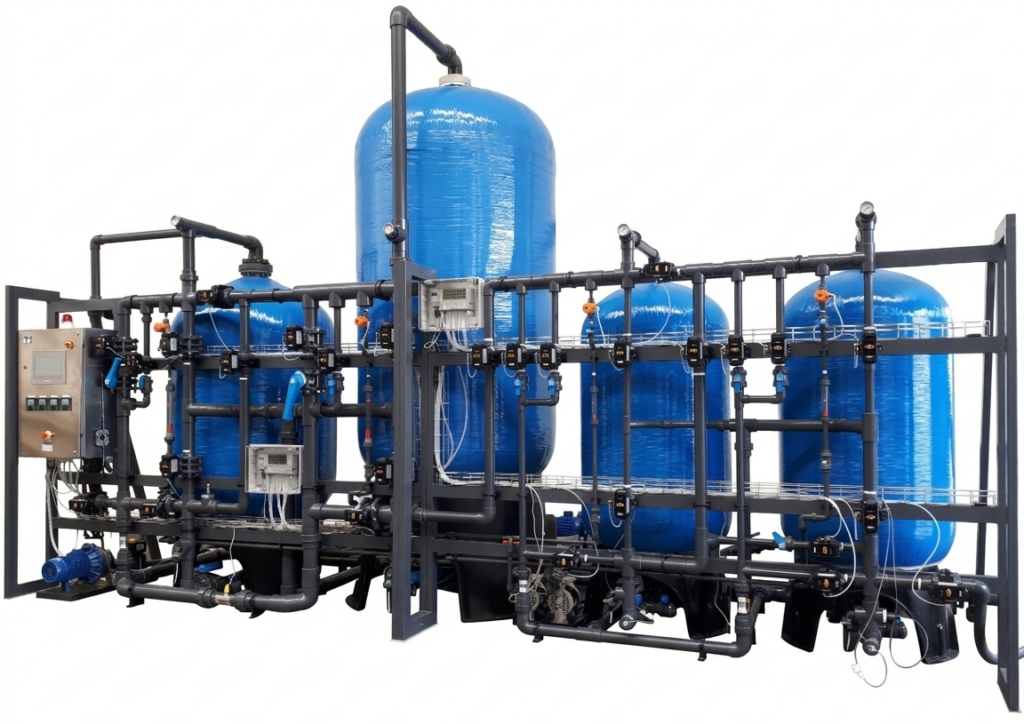
During operation, the juice passes through a series of ion-exchange resin columns, each targeting specific ions to achieve the desired quality. Depending on the targets, the system typically includes strong and weak acid/anion resin stages. All components are mounted within a stainless-steel frame for durability.
Integration possibilities with vacuum evaporators enable the transition to a concentrated juice state, ready for further use in production processes that require precise sweetness levels.
Sizing inputs
- Juice type and ionic profile.
- Desired °Brix after concentration.
- Flow rate and operational volume.
- Raw material variations and seasonal impacts.
- Final product specifications and integration needs.
Each system is configured to match the specific feed composition and concentration goals with optimal efficiency.
FAQ
In juice processing the terms are often used interchangeably: both refer to removing ionic species (minerals and other ionized fractions). The result is a “rectified” juice with reduced non-sugars.
Because lowering non-sugars helps prevent scaling, precipitation and instability during and after concentration, improving evaporator reliability and final concentrate quality.
Depending on the configuration, resins mainly remove mineral cations and anions and other ionic fractions; organic acids and related compounds may also be reduced depending on the process target.
After rectification the solution is commonly around 15–18 °Brix (feed-dependent). Vacuum evaporation can typically reach about 70 °Brix for the concentrate.
Yes. With PLC, process measurements and automated sequences, the plant can operate 24/7, log alarms and execute wash/regeneration cycles while minimizing utilities and losses.
“`