



Pentafood resin plants for pesticide removal are industrial packed‑column systems designed to mitigate pesticide residues in food matrices such as fruit juices, extracts, purées and fruit‑based ingredients. The technology employs food-grade selective resins (adsorbent and ion-exchange, depending on the target), engineered for consistency in operation and quality assurance.
Pesticide removal with resin-based systems
Process overview
Post-pressing, potassium and tartaric acid coexist in solution, leading to the potential formation of potassium bitartrate and calcium tartrate. Unless effectively controlled, these salts can precipitate and settle, negatively affecting product quality and marketability.
Engineering and automation
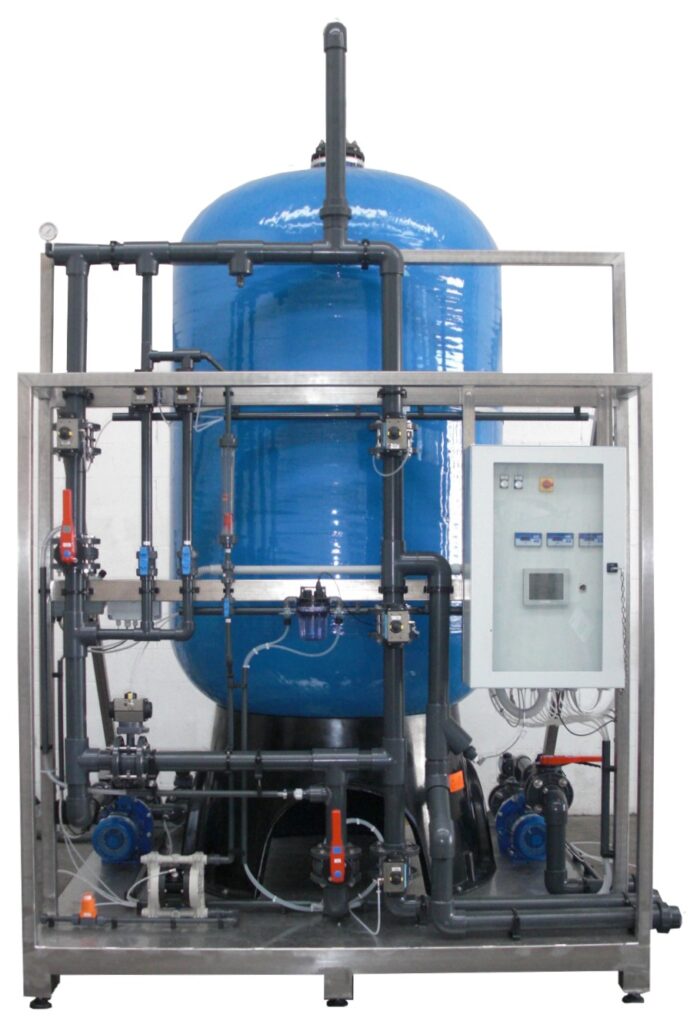
The system functions in a cyclic mode: commencing with a service phase until resin saturation, followed by automatic regeneration utilizing a suitable regenerant and systematic rinses. An integrated PLC with touch-screen interface oversees recipes, with cycle parameters safeguarded. Inline metrics for flow and volume enhance operational consistency.
Key advantages
Technical configuration
Process liquids traverse one or more columns containing a cation exchange resin. This resin captures cations such as K+ and Ca2+, while releasing hydrogen ions (H+). Lowering cation levels curtails the formation of tartrate salts, thereby enhancing long-term product stability.
The entire apparatus is mounted on a stainless-steel self-supporting frame. A stainless-steel pump delivers the liquid to the resin columns, while pneumatically operated valves control the flow for optimal and hygienic operation.
Sizing inputs
- Matrix type (juice, extract, purée) and instability metrics.
- Initial concentrations of K+ and Ca2+.
- Desired flow rates and campaign volumes.
- pH limitations and constraints on total acidity.
- Upstream filtration and load of suspended substances.
In numerous instances, processing just 5 to 25 percent of the product and re-combining is adequate to achieve overall stability while minimizing pH and acidity fluctuations.
FAQ
It treats fruit juices, extracts or other fruit‑based matrices through a selective food‑grade resin column to reduce pesticide residues against a defined target, validated by multi‑residue analytics.
It is the simultaneous presence of multiple active substances. Even at low levels per compound, the total and batch variability may require a dedicated treatment and control strategy.
The system is engineered to target pesticide residues while preserving the matrix as much as possible. Overall impact is verified through sample trials and analytical/sensory checks.
Depending on the project, the plant can treat juices, extracts, purées and other fruit‑based ingredients by defining upstream filtration, resin selection and recipes for the specific matrix.
At the end of each run the plant performs rinsing and regeneration according to a validated procedure. PLC automation restores the resin bed capacity for the next campaign.
By comparing before/after analytical results on representative samples and on the required pesticide panel. Results are used to define recipes, BV, flow rates and stop criteria for repeatability.
Yes. Service, rinsing and regeneration sequences are managed by a touch‑screen PLC with recipes and alarms, reducing operator dependency.
Matrix properties (°Brix, turbidity, temperature), flow rate and volumes, target pesticide list and reduction goals, plus layout constraints, utilities and handling of rinsing/regeneration solutions.