



Increasing grape must acidity with ion exchange resins offers a reliable method to adjust pH levels by reducing alkalinizing cations such as potassium (K+) and calcium (Ca2+). STAB K Plus resin plants cater specifically to winemaking, utilizing regenerable food-grade resins for controlled and predictable outcomes.
Must acidity increase systems with resins
Process overview
Must acidification is crucial when pH is elevated, ensuring smooth fermentation and enhanced tartrate stability by minimizing crystal formation. Reduced cation levels can prevent issues related to supersaturation and crystallization.
Engineering and automation
Systems are mounted on compact skids and harness pneumatic valves for precise flow control. A PLC automates phases like service and regeneration, ensuring consistency and safety in operations, supported by inline monitoring tools for metrics like pH and conductivity.
Key advantages
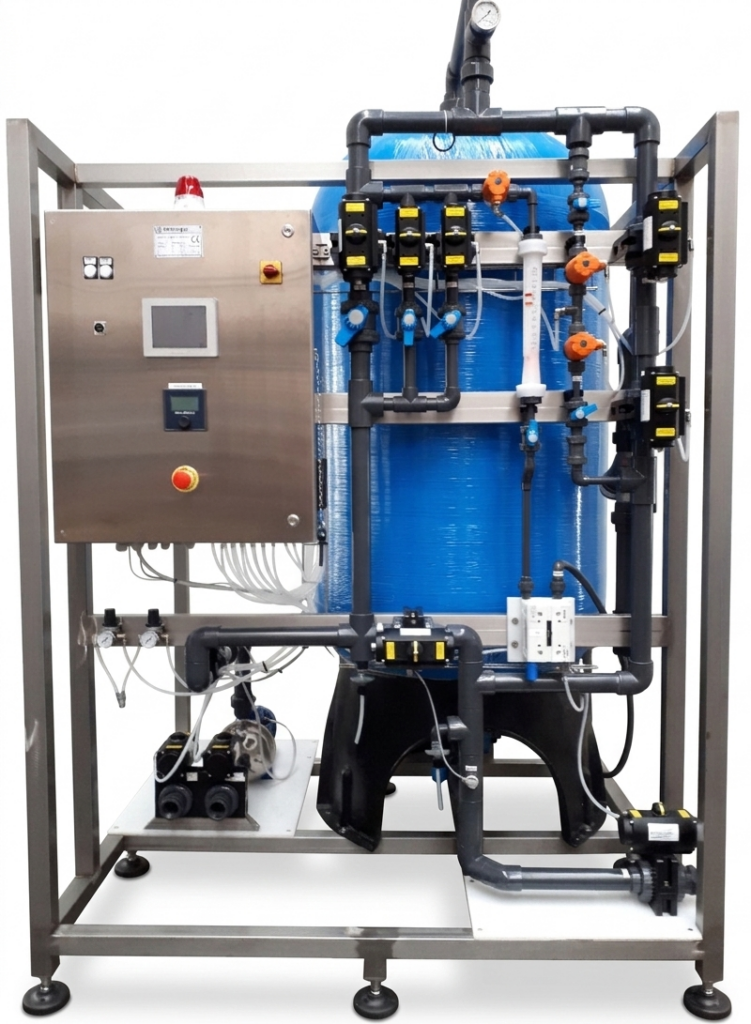
Technical configuration
Filtered must passes through columns filled with cation exchange resin, which exchange cations like K+ and Ca2+ with H+, effectively lowering pH and enhancing stability. The stainless-steel design ensures durability and hygiene through carefully managed valve operations.
Sizing inputs
I am text block. Click edit button to change this text. Lorem ipsum dolor sit amet, consectetur adipiscing elit. Ut elit tellus, luctus nec ullamcorper mattis, pulvinar dapibus leo.
FAQ
Filtered must passes through a cation resin in acid form that captures K+ and Ca2+ while releasing H+. The treated fraction becomes more acidic and lower in pH; blending with untreated must reaches the target across the full batch.
Treating a portion and blending back provides tighter control of pH and acidity, reduces overtreatment risk and optimizes time and consumptions. The best fraction depends on the matrix and should be defined by trials and analytics.
pH, titratable acidity, potassium and calcium, turbidity/colloids and tartrate instability indicators. Volumes, required flow rate and sensory constraints of the final style are also needed.
In some matrices-especially reds-overly strong treatment may change colour or sensory attributes. That is why stop criteria are set and trials are recommended before inline implementation.