


Pentafood modular multi-service resin plants are tailored for large wineries requiring diverse treatments in a unified framework. The system offers flexibility in conducting decolorization, grape must rectification (RCM), pH stabilization, and demetallization, utilizing specialized resin modules and automated processes.
Modular multi-service plants
Process overview
Engineered to handle multiple grape processing needs, these plants leverage a modular architecture that allows flexibility in treatment operations. This adaptability caters to varied harvest conditions, enhancing campaign planning and execution for specialized winery requirements.
Engineering and automation
Each plant is integrated with a touch-screen PLC facilitating recipe management and automation. This ensures precise treatment execution and operational efficiency. Scalable designs allow growth through additional columns or functionalities as necessary.
Key advantages
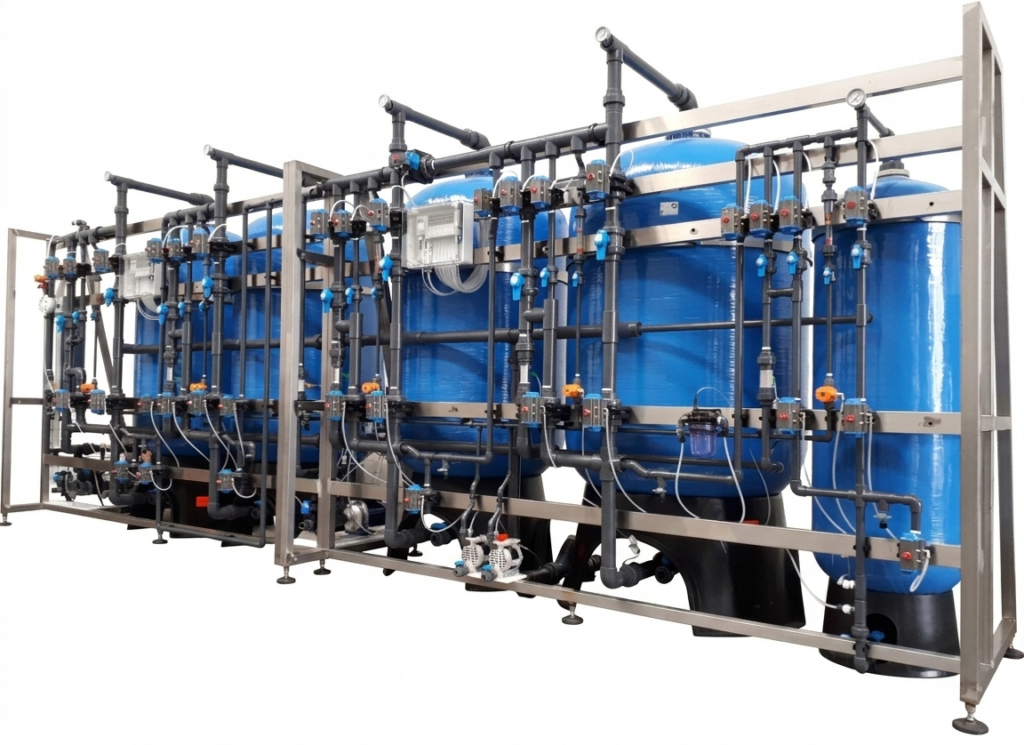
Technical configuration
The plant facilitates a multi-step process involving columns of ion-exchange resins for targeted extraction treatments such as decolorization and ion removal. Its modularity ensures adaptability to different processing demands and batch variabilities through automated control systems.
Constructed on a robust frame, it includes pneumatically actuated valves and stainless-steel structures to secure operation integrity. Stainless-steel pumps advance the flow, ensuring consistent treatment and long-term plant stability.
Sizing inputs
- Feed matrices like must and wine; filtration level.
- Quality targets: color, pH, conductivity.
- Flow rate and campaign volumes.
- Layout and utility constraints.
- Continuous operation needs and remote management.
FAQ
It is a modular platform integrating multiple resin‑based treatments (decolorization, RCM rectification, pH modulation/stabilization and demetallization) that can run as standalone processes or combined campaigns under one automation architecture.
Mainly large wineries or vinification hubs handling high volumes and multiple treatment requirements during the season, aiming to optimize footprint and operations.
Yes. The modular design supports separate or combined treatment schedules depending on volumes, quality targets and plant availability.
Product passes through adsorbent resin that retains colour compounds; at end of cycle a colour stream can be recovered and the bed is restored through automated recipes.
It is an ion‑exchange demineralization step that removes salts and ionic species, producing a clearer sugar solution suitable for subsequent concentration to RCM.
Ion‑exchange resins and dedicated recipes allow controlled pH/acidity adjustment and stabilization to reach the process target with repeatability.
Typically iron and, when required, other metals such as copper and lead using selective resins designed to preserve the matrix.