

Agave juice is a fructose-rich sweetener that offers high solubility and less crystallization. However, it can present challenges like color variability and off-odors due to mineral salts and organic compounds. Our adsorbent resin plants are designed to standardize these aspects, enhancing repeatability and quality.
Agave juice production plants
Process overview
Our plants integrate modular steps for agave juice processing, starting with the harvest and progressing through milling, dissolution, and pre-filtration to ensure quality. Key processes such as decolorization and deodorization are centralized to ensure a consistent final product.
Engineering and automation
Automated systems using PLCs manage flows, timing, and safety interlocks for continuous and consistent operations. This technology guarantees 24/7 continuity while enhancing repeatability and product quality with minimized human intervention.
Key advantages
Technical configuration
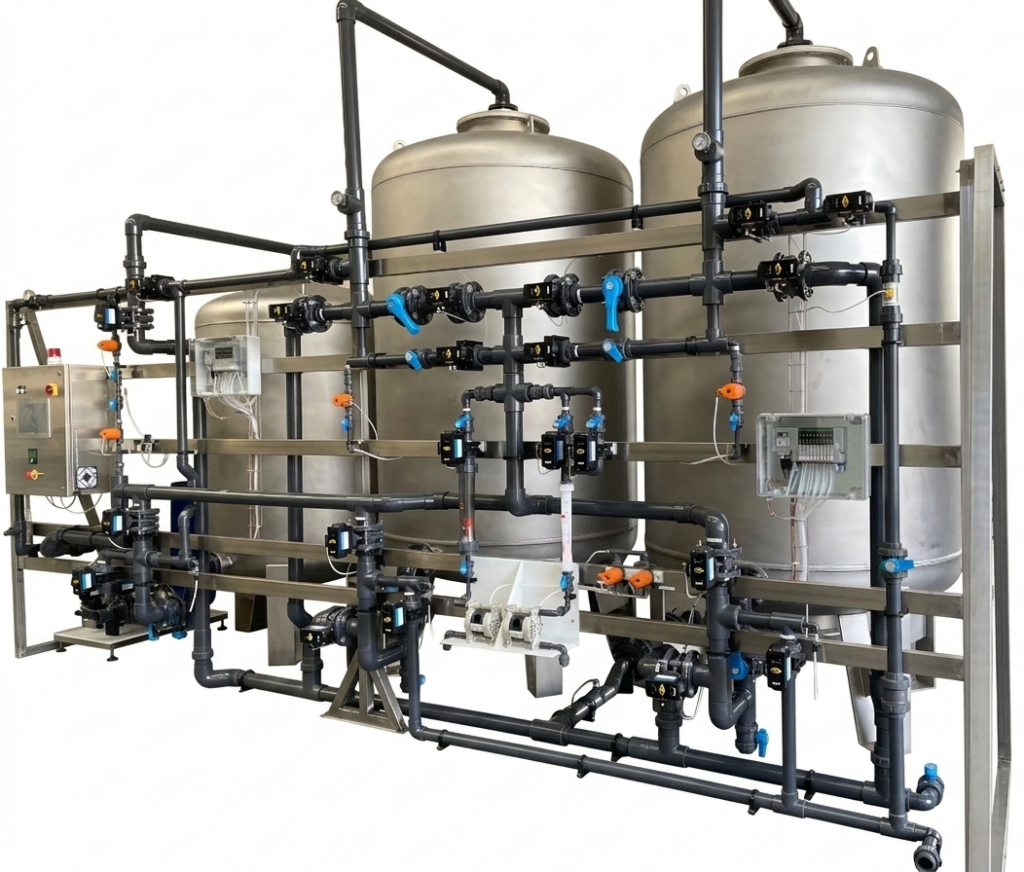
The treatment process involves food-grade adsorbent resins within columns through which the juice passes. These resins selectively remove color bodies and odor fractions, optimizing clarity and reducing batch variability. The system includes a series of pre-defined cycles to ensure performance and quality.
Modular column setups are customized to client flow rates and specifications ensuring maximum operational efficiency. Automated controls and pneumatic valves streamline operations for enhanced reliability.
Sizing inputs
- Agave source and variability.
- Initial mineral and organic composition.
- Desired clarity and aroma standards.
- Flow rate and batch volumes.
- Pre-treatment and filtration stages.
Our targeted approach allows for customization to achieve specific decolorization and deodorization targets efficiently.
FAQ
To control final tone, reduce batch variability and obtain a lighter syrup with repeatable specifications. In many cases, the process also supports deodorization.
Adsorbent resins mainly retain organic color bodies and can also reduce fractions linked to off-odors, depending on the matrix and plant configuration.
Usually 2 or 3 columns. The selection depends on inlet quality and the required clarity defined by the product specification.
Yes. Pre-filtration removes solids and colloids, protects the resin bed and improves stability and repeatability of the treatment.
After rinses to recover product and remove residual sugars, resins are typically regenerated with a water + caustic soda solution to restore adsorption capacity.