
Food-grade resin plants

Food-grade resin plants for juices, musts and food process solutions

Food-grade resin plants are liquid treatment systems based on resins certified for food contact, designed to remove or modulate unwanted components (color, bitterness, metals, pesticides, salts, acids) while preserving product integrity. They are widely used in fruit and beverage processing, wineries and industrial food operations where consistent quality and repeatable results are required.

Pentafood designs and builds scalable food-grade resin plants tailored to the product and process objectives, featuring PLC automation and optional remote monitoring and diagnostics.

What food-grade resin plants are

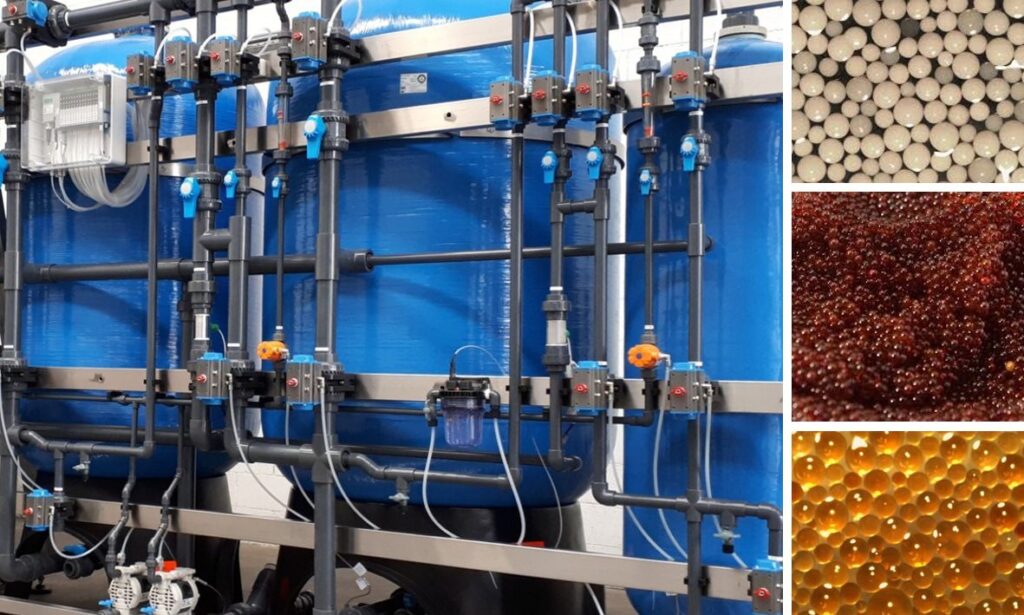
Food-grade resin plants are column systems using ion exchange resins and or adsorbent resins to remove or modulate specific components in juice or must. The treatment is engineered to be selective, traceable and easy to integrate into production lines.

The goal is a controlled process that supports food quality targets while maintaining operational continuity.

How they fit into food production

Pentafood plants are PLC controlled across all phases, including processing, regeneration and storage. Automation enables anomaly detection with local alarms and, where configured, remote notifications to support operational continuity.

Key advantages

  • Selective action on critical parameters with process control.
  • Repeatable industrial process for various food applications.
  • Automation ready sequences with alarms and optional remote support.

Main applications of Pentafood food-grade resin plants

Below are common applications. Each solution is engineered according to matrix, objectives and line constraints, with defined targets and repeatable operation.

Solutions designed for bitterness reduction without additives, ensuring enhanced flavor profiles in juices.

Adsorbent resin plants for musts and juices to selectively reduce unwanted color while maintaining quality.

Systems specifically tailored for citrus juices and beverage bases to adjust acidity levels effectively.

Designed to eliminate metals such as iron, copper and lead in food solutions, ensuring safety and quality.

Targeted solutions for the removal of pesticides and specific contaminants in juices and extracts.

Systems engineered for high-value essence extraction or color fraction recovery, enhancing product value.

How to size a food-grade resin plant

Sizing is driven by the matrix, the process target and the outlet specification, plus production constraints and utility management. A correct sizing approach supports repeatability and operational continuity.

  • Matrix juice or must, process target and outlet specification.
  • Flow rate, campaign volumes, operating windows and line constraints.
  • Initial analytics and targets, including pH, metals and color where relevant.
  • Regeneration strategy and utilities management according to configuration.

Why choose Pentafood

Pentafood designs food-grade resin plants with a production focused approach, combining selective treatment, traceable operation and PLC controlled sequences.

Plants are engineered to be easy to integrate into production lines and scalable across different application sizes and campaign volumes.

FAQ

A food-grade resin is an adsorbent, ion-exchange or selective resin suitable for food-contact applications and intended for food processing without releasing unwanted substances. It should come with the manufacturer’s food-contact suitability documentation and clear start-up/conditioning and regeneration procedures compatible with the intended use.

Adsorbent resins capture organic molecules such as color bodies, polyphenols, bitter compounds and some contaminants. Ion-exchange resins exchange ions with the product and are used for demineralization, pH and ionic balance control, deacidification/acidification and metal/salt reduction.

Typical products include juices and concentrates (apple, pear, citrus, pomegranate, date), musts and food streams, syrups and sugar solutions. Feasibility depends on composition, suspended solids, quality targets and process constraints.

Yes. In industrial plants regeneration is managed by PLC with automatic sequences, controlled dosing and dedicated rinses. Eluates are collected and routed to neutralization/treatment according to the site’s wastewater layout, with solutions aimed at reducing consumptions and simplifying operations.

The process is engineered to act on the target (color, bitterness, metals, pesticides, acidity) while minimizing impact on sensory profile. Resin selection and cycle settings are critical; for sensitive applications, pilot trials and analytical checks are performed before final sizing.

We need flow rate and volumes, inlet product analyses (Brix, turbidity, color/transmittance, pH, acidity, conductivity, metals/pesticides), outlet targets and site constraints (operating hours, utilities, space, wastewater management). These inputs define columns, resins, consumptions and automation.