



Grape juice (must) can be demineralized and rectified using ion exchange resin plants to produce MCR – Rectified Concentrated Must. The process selectively removes mineral salts, nitrogenous compounds and unwanted fractions while preserving the sugar stream, delivering a clear, stable aqueous solution suitable for subsequent concentration and food & beverage use.
MCR must rectification plants
Process overview
Must rectification aims to separate sugars from species affecting colour, haze, and stability. Demineralization lowers the salt load, while rectification enhances clarity and ensures product compliance. Cation and anion exchange resins work collaboratively to target and adjust undesired components in the must.
Engineering and automation
Plants feature automated cycles managed by PLC systems to oversee service, washing, and regeneration phases. Monitoring of flow, conductivity, and pH ensures set-point adherence and operational consistency. This automation ensures precise and reliable rectification processes.
Key advantages
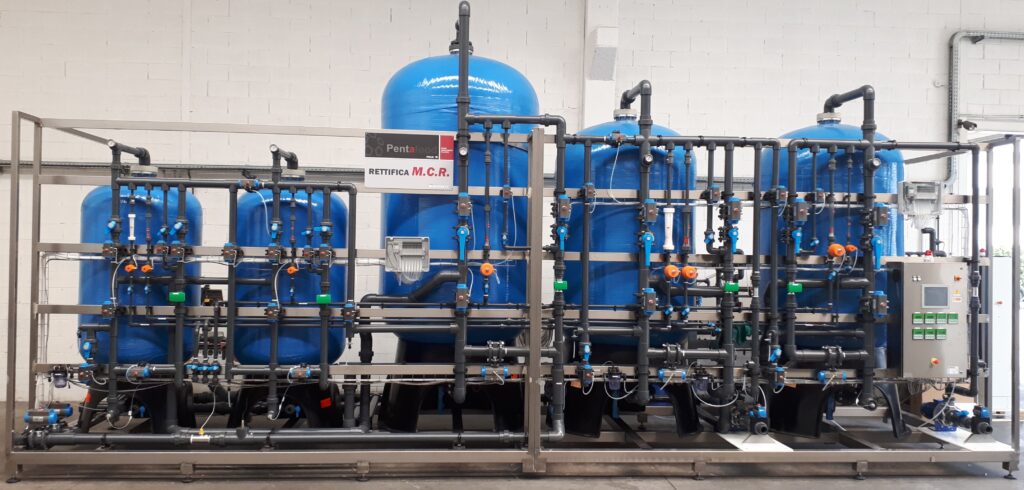
Technical configuration
MCR rectification involves a sequence of cation and anion exchange columns. These columns work cohesively to deliver a must that meets specific conductivity, clarity, and pH standards. The plant is typically equipped with technology to automatically adjust parameters, ensuring consistent processor outcomes.
Pretreatment systems are included for filtration and turbidity control, protecting the resin and extending the plant’s operational life. Integration of timers and sensors helps manage the precise cycles of each phase.
Sizing inputs
- Feed must composition-sugars, salts, and other components.
- Desired output-conductivity, clarity, and specifications.
- Flow rate, daily volume, and batch or continuous operation.
- Initial and final colloidal levels and upstream filtration settings.
- Regeneration and effluent strategies, with utility availability.
Critical parameters include composition, flow, and specifications, ensuring the design aligns with operational and site requirements.
FAQ
MCR is a demineralized and clarified must where the sugar fraction is separated from salts, nitrogenous compounds and part of polyphenols. Rectification improves clarity, stability and compliance with specifications.
Demineralization mainly reduces mineral ions (cations/anions). Rectification also targets fractions affecting colour, haze and oxidative stability, improving product transparency.
Food‑grade cation and anion exchange resins are typically used in dedicated columns. Media selection and sequence depend on matrix and targets for conductivity, pH, clarity and acids recovery.
Anion resins may reversibly adsorb a share of polyphenols, supporting clarification and reducing colour/oxidation‑related fractions. The effect should be validated by trials on the specific product.
Many layouts include a final cation column dedicated to pH correction. Control relies on defined set‑points and stop criteria supported by pH/conductivity monitoring where installed.
Yes. By integrating selective resins, organic acids can be retained and then recovered through dedicated regeneration steps, producing a separate stream for valorization.
“`