



Decolorization of grape must or juice involves a treatment designed to minimize or eliminate color-forming compounds to achieve a visually clear product or a specific color profile. This process is crucial when producing decolorized concentrated must or standardized bases, especially when reducing phenolic components to enhance product stability and sensory consistency.
Must decolorization plants
Process overview
In the initial phase, grape must and juice contain potassium and phenolic compounds that can lead to unwanted coloration. These compounds often precipitate, creating sediment that detracts from the product’s appeal. While such precipitates are not a microbiological issue, they can adversely affect consumer perceptions and marketability.
Engineering and automation
The technology operates in a cyclic rhythm: a service phase ending at resin saturation, followed by an automatic regeneration sequence utilizing appropriate solutions and controlled rinsing. A programmable logic controller (PLC) with a touch-screen interface governs operational recipes; parameters can be secured with password protection. Real-time flow and volume measurements enable rigorous traceability and consistent performance.
Key advantages
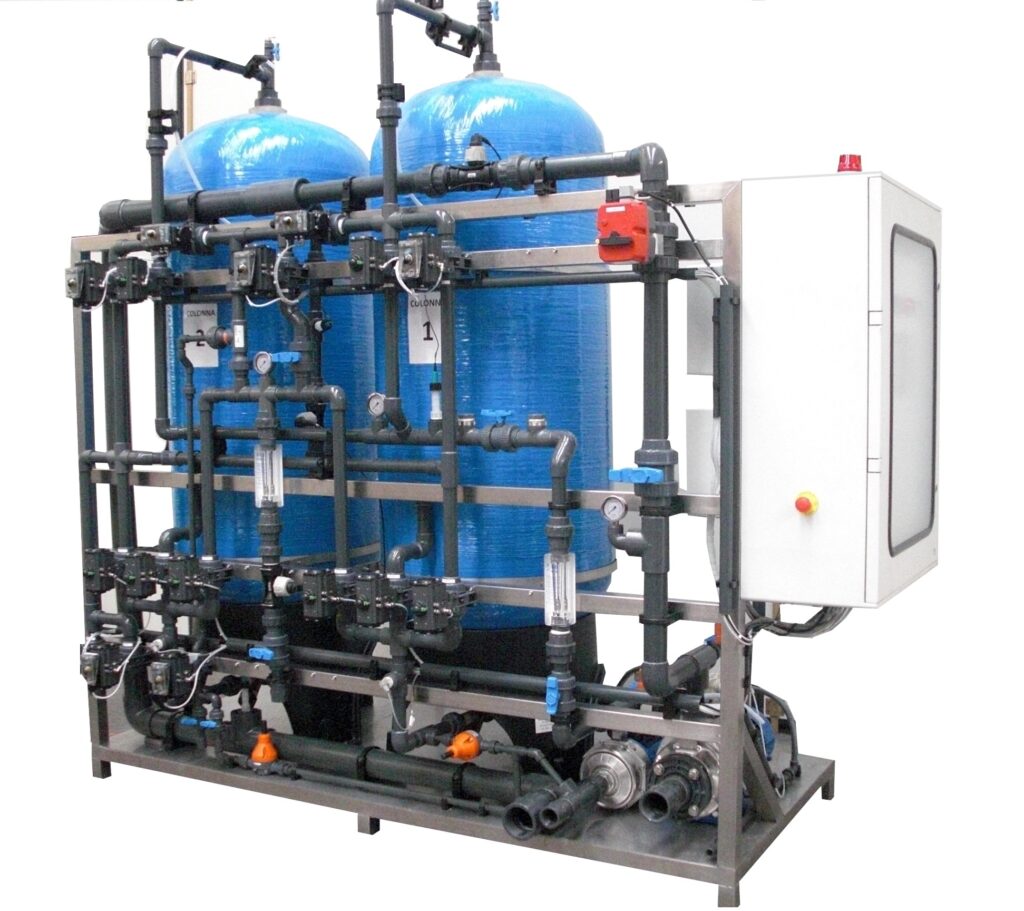
Technical configuration
The system operates with one or multiple columns that host a food-grade resin designed to capture detrimental color-forming cations such as anthocyanins while releasing safe ions. This action effectively diminishes the potential for color instability in the final product.
The plant structure is built on a stainless-steel frame that provides robust support. Juice is delivered via a stainless-steel pump through the resin columns, while pneumatically controlled valves direct the flow, ensuring sanitary conditions and precise management of the treatment process.
Sizing inputs
- Type of grape must and its decolorization requirements.
- Initial anthocyanins and other contaminants.
- Juice flow rate during treatment.
- pH levels and total acidity constraints.
- Pre-treatment filtration and particulate load assessment.
In most cases, processing merely 5 to 25 percent of the grape juice and reintegrating it results in an overall clarity while minimizing any shifts in pH levels and acidity.
FAQ
It reduces or removes color-forming substances (mainly anthocyanins and other phenolic fractions) to obtain a clear must/juice or a controlled color profile, useful for products such as decolorized concentrated must.
Primarily anthocyanins, tannins and polyphenols; catechins and proanthocyanidins may also be reduced, and in many applications some odor-causing organic fractions are decreased as well.
Yes. Pre-filtration lowers suspended solids and colloids, protects the resin bed and improves adsorption process stability.
The process is designed to target mainly color compounds. The impact on other constituents depends on the matrix and resin set, but the goal is to preserve original characteristics except for color.
After product recovery and sugar removal rinses, regeneration can be done with caustic soda (with optional purification on a dedicated column) or with an alcoholic solution; in the latter case, distillation can recover alcohol for reuse.
Yes. With PLC control and automated service/rinse/regeneration sequences, stable operation is possible without constant staffing under standard conditions.
Yes. In many applications adsorbent resins can decolorize and deodorize vegetation water, supporting water recovery and reducing discharge.