


Gum arabic (acacia gum, E414) decolorization reduces colour‑forming substances and supports ash/sediment control, improving appearance and batch repeatability. Pentafood plants combine a chemical decolorization step with dedicated food‑grade resins in packed columns, with automatic cycles and controlled regeneration.
Gum arabic decolorization plants
Process overview
Gum arabic is processed to reduce undesirable colour compounds, which allows for better product quality and stability. The system utilizes dedicated resin treatment to achieve consistent results. Maintaining effective quality control throughout the process is essential to ensure the desired outcomes.
Engineering and automation
Our decolorization plants are optimized for automation, featuring PLC control for enhanced traceability. The cycle is designed for operational efficiency, including automatic rinsing and regeneration to maintain peak performance and minimize downtime.
Key advantages
Technical configuration
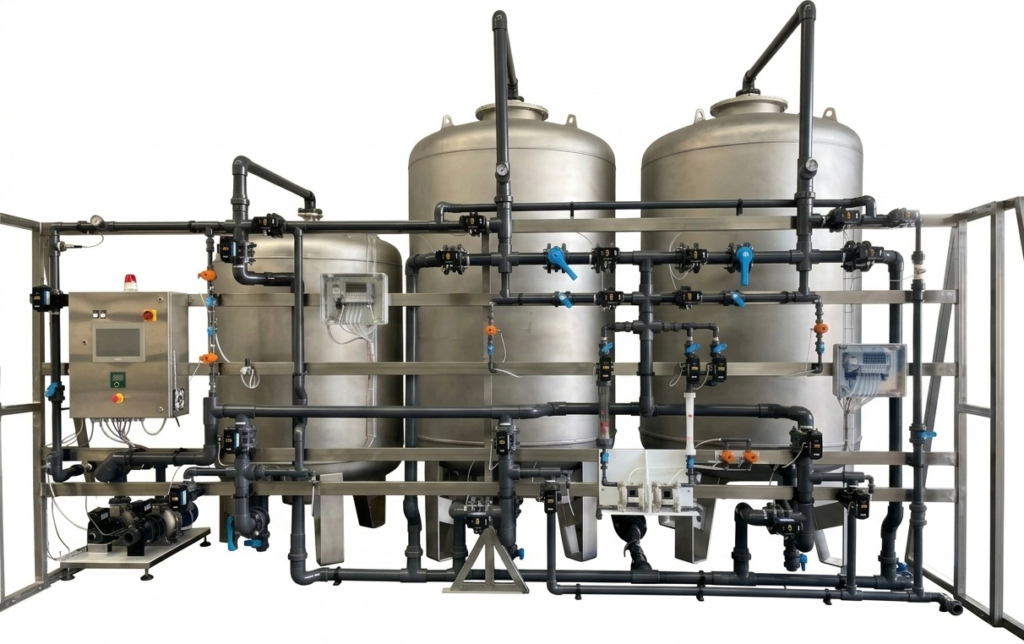
The gum arabic solution is processed through a series of cation exchange resin columns. Each resin effectively captures the cationic components while releasing hydrogen ions, which leads to a significant reduction in unwanted colour. This continuous flow system is designed for efficiency and high-quality output.
The entire setup is mounted on a robust structure, ensuring durability. Each component is designed for seamless integration within existing production facilities, ensuring minimal disruption during installation.
Sizing inputs
- Solution concentration and viscosity parameters.
- Initial colour and defined targets.
- Ash content measurements.
- Filtration level and upstream treatment details.
- Flow rates and effluent constraints.
Effective sizing requires comprehensive analysis to ensure optimal system performance while maintaining product integrity throughout the decolorization process.
FAQ
It reduces colour‑forming substances in gum arabic solution and can support ash/sediment control, delivering a lighter and more uniform product.
Yes. Safety pre‑filtration removes impurities and particulates, protecting the resin bed and improving repeatability.
Typically one or two treatment reactors plus an automatic resin system; sizing depends on throughput and quality targets.
In many configurations it may reduce selected cationic fractions and support sediment control, depending on matrix and objectives.
After a rinse step to recover retained gum, the resin is regenerated with a water‑and‑acid solution followed by rinses under defined procedures.
Yes. PLC‑controlled cycles can manage production, washing and regeneration to reduce operator needs.
Depending on specs: colour metrics, turbidity, treated volumes and, where installed, conductivity or pH.
Key inputs include concentration, initial colour and target, ash content, filtration level, flow rates/volumes, utilities and effluent constraints.