



Resin plants for grape must de‑ironization are packed‑column systems designed to selectively remove metals, particularly iron, copper, and lead. They aim to purify must while preserving its properties through high-yield, automated cycles with minimal chemical use.
Must deferrization systems
Process overview
During treatment, must flows through a column with selective resin tailored for metals like Fe, Cu, and Pb. The selectivity of the resin ensures contaminants are targeted without altering the must composition. Adjustable blending allows fine-tuning to meet outlet targets.
Engineering and automation
Our systems are designed for full automation, executing service, washing, and regeneration sequences with minimal human intervention. This automation ensures consistent operation across batches through precise control of valves, sequences, and interlocks.
Key advantages
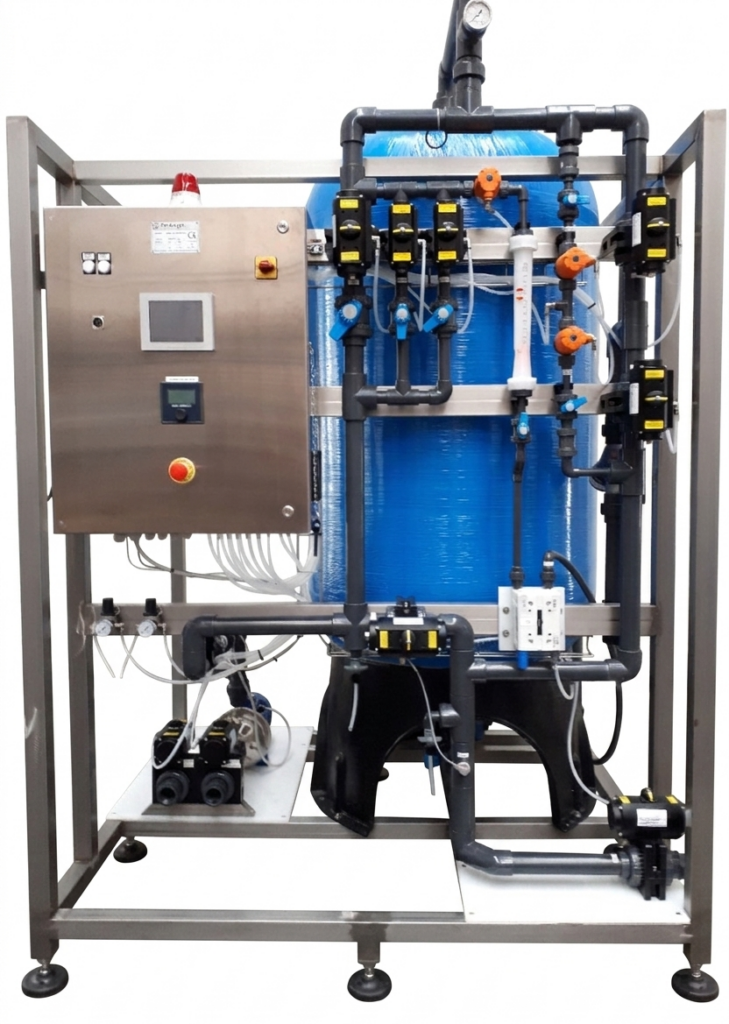
Technical configuration
Grape must flows through columns packed with selective resin optimized for iron and metals like copper and lead. Automatic sequences manage the flow and achieve desired metal reductions. The stainless-steel frame and pump systems assure robust performance and hygiene.
Designed for streamlined operation, the system manages flows with pneumatically powered valves and integrates seamlessly with winery operations.
Sizing inputs
- Initial metal concentrations for Fe, Cu, Pb, and target outcomes.
- Flow rates and volume processed per campaign.
- Must characteristics including turbidity and temperature.
- Blending strategy specifications and quality standards.
- Utility needs and constraints for handling effluent.
Conducting initial trials helps in setting accurate parameters for repeatable and optimal treatment performance.
FAQ
It is a packed‑column resin treatment designed to remove mainly iron from must and, when needed, also other metals such as copper and lead, while preserving product properties as much as possible.
They may originate from processing steps, equipment contact, storage conditions or raw material characteristics; in some cases metals can exceed the process target.
They are selected to preferentially bind target metals (Fe, Cu, Pb) with the aim of preserving the must matrix; performance is verified through product trials and analytics.
Yes, the standard configuration uses one column with selective resin, sized to the winery flow rate and volumes.
It is the controlled mixing of treated and untreated streams to fine‑tune the final metal concentration and achieve the required outlet target.
Regeneration is automatic and uses an acidic reagent (H₂SO₄ or HCl). Desorbed metals are removed and the resin is restored for the next cycle.
Dedicated washes (including air‑water push‑down) and a final rinse with conductivity control are used to confirm proper bed restoration.