



Reverse osmosis plants are designed to generate low-salinity primary water suitable for food processing applications. Utilizing a membrane separation technique, they ensure consistent water quality vital for various industrial processes.
Primary water reverse osmosis plants
Process overview
The reverse osmosis process employs pressure to drive water through a semi-permeable membrane, eliminating impurities while producing quality water. This ensures the reduction of salts and other contaminants essential for food production.
Engineering and automation
Our RO systems are equipped with advanced automation for seamless operation. Using PLC technology, we ensure efficient monitoring of parameters and protective strategies for long-term functionality.
Key advantages
Technical configuration
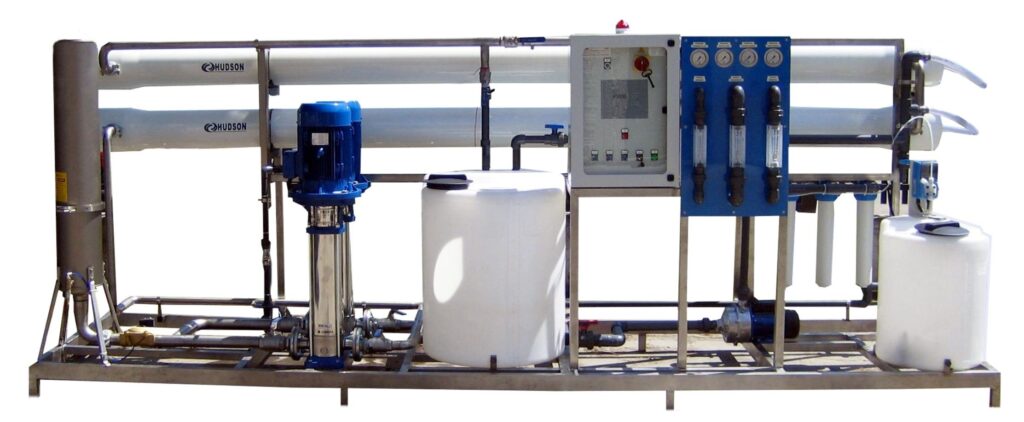
The system includes membrane modules and integrated instrumentation for monitoring pressures and flows. Water undergoes filtration followed by treatment through high-efficiency membranes that remove salts and impurities.
The system is assembled on a durable stainless-steel frame, ensuring stability and hygiene within food processing environments.
Sizing inputs
- Required primary-water flow rate and consumption profile.
- Feedwater quality including salinity and turbidity levels.
- Target permeate conductivity for consistency.
- Recovery rate and management of concentrate output.
- Integration options with existing filtration systems.
Assessing these factors ensures the RO system meets operational needs while providing reliable water quality.
FAQ
It is low-salinity service water with repeatable quality, used for washes, regenerations and process utilities where water consistency is required.
Permeate is the treated water that passes through the membrane with reduced salts and conductivity; concentrate (retentate) is the stream where salts accumulate and is discharged or recovered.
RO significantly reduces dissolved salts (TDS), conductivity and hardness. Results depend on feedwater quality, membrane type and pretreatment.
Yes, it is usually necessary to protect membranes (e.g., filtration and/or softening) and to ensure stable performance and lifetime.