


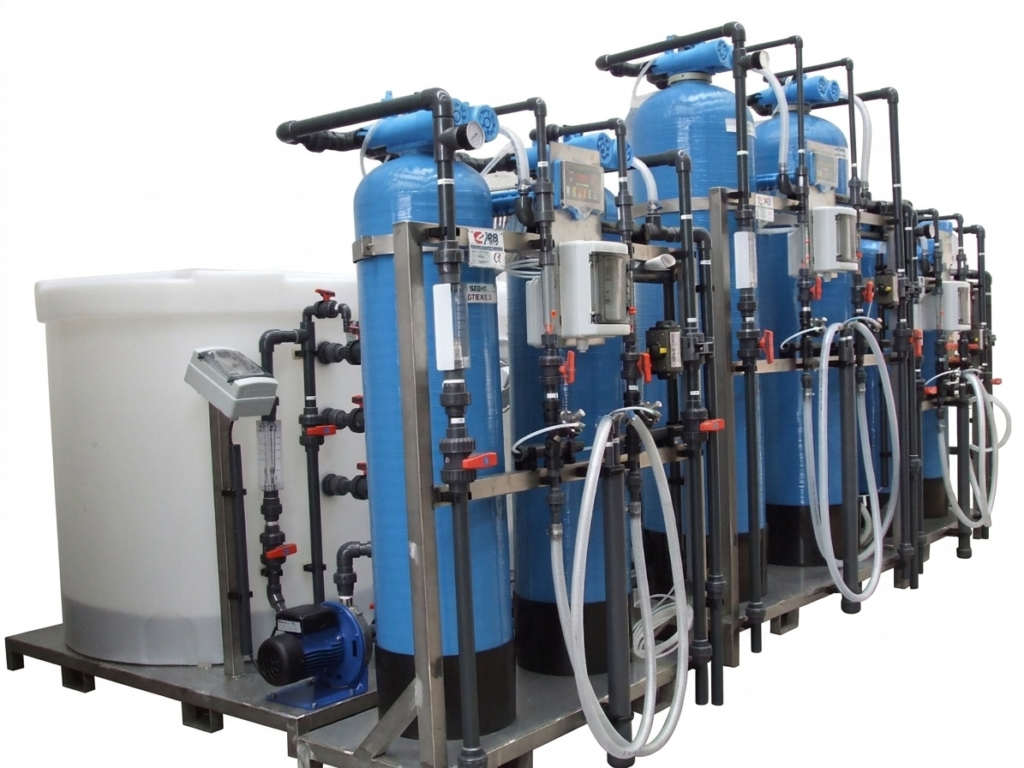
A water decationization plant is a specialized ion-exchange resin system aimed at removing dissolved cations such as calcium, magnesium, and sodium, thereby producing a more controlled “primary” process water. This treated water is widely utilized in the food and beverage industry, particularly in wineries for rinsing and regenerating other resin-based systems.
Water decationization plants
Water decationization plant: ion‑exchange resin system for process primary water
Process overview
During the decationization process, water must traverse a cation exchange resin column, where it exchanges unwanted ions for H⁺ ions to maintain quality. This treatment is crucial in food production, as potassium bitartrate and calcium tartrate can crystallize out of solution, potentially affecting consumer perception and product quality.
Engineering and automation
The entire system is designed for cyclic operation, including a service phase followed by automated regeneration to maintain performance. A sophisticated PLC with a user-friendly interface supervises these cycles, providing traceability and therefore ensuring optimal functionality.
Key advantages
Technical configuration
During operation, wine flows through a cation exchange resin column that effectively captures cations such as potassium and calcium, allowing hydrogen ions to be released into the water. This process significantly diminishes the levels of these critical ions, curbing the formation of tartrate salts that can compromise quality.
The complete system is structured on a robust stainless-steel framework, featuring pneumatic valves that direct the flow and ensure controlled and sanitary operations.
Sizing inputs
- Inlet water quality: hardness, alkalinity, and metals present.
- Desired flow rate and expected daily/campaign volumes.
- Primary water specifications and target stop criteria.
- Chemicals constraints for safety and regeneration by-products.
- Process design: equipment and installation limitations.
In many applications, treating only 10 to 20 percent of the total water can yield satisfactory quality while minimizing adjustments to pH and acidity.
FAQ
It removes dissolved cations (e.g., Ca²⁺, Mg²⁺, Na⁺ and other positive ions) to produce a more controlled primary process water.
Softening typically exchanges Ca/Mg for Na⁺ (brine regeneration), while decationization exchanges cations for H⁺ (acid regeneration) and is often part of demineralization.
Most commonly hydrochloric acid (HCl) or sulfuric acid (H₂SO₄), selected based on performance, safety and site constraints.
Through recipe stop criteria such as treated volume, time and/or control parameters (e.g., conductivity), depending on the instrumentation installed.
It is often used as primary water for rinsing and regeneration of resin systems (decolorization, MCR rectification, stabilization, pH adjustment, demetallization).
Yes. Controller/PLC automation manages service, backwash, regeneration and rinsing with safety interlocks and alarms.
Inlet water quality (hardness/conductivity/alkalinity), flow and volumes, target primary‑water specification, and constraints for chemicals and effluent handling.
Yes. Skid systems are engineered for quick integration with tailored hydraulic/electrical connections and adaptable automation logic.