



Ion exchange resin systems for wine tartaric stabilization are engineered to achieve long-term tartaric stability by reducing the cations that drive tartrate precipitation, mainly potassium (K+) and calcium (Ca2+). Pentafood STAB series plants use food-grade certified cation exchange resins and are designed for repeatable performance through automatic service and regeneration cycles.
Wine stabilization plants with resins
Process overview
After pressing, potassium and tartaric acid coexist in the same solution and can form potassium bitartrate and calcium tartrate. These salts may precipitate as crystals and settle as sediment. While not typically a microbiological defect, crystals are often disliked by consumers and can impact packaging and marketability.
Engineering and automation
The system operates in cyclic mode: a service phase until resin exhaustion, followed by automatic regeneration with a suitable acid regenerant and controlled rinses. A PLC with touch-screen HMI manages recipes; cycle parameters can be password-protected. Inline flow and volume measurement supports traceability and consistent operation.
Key advantages
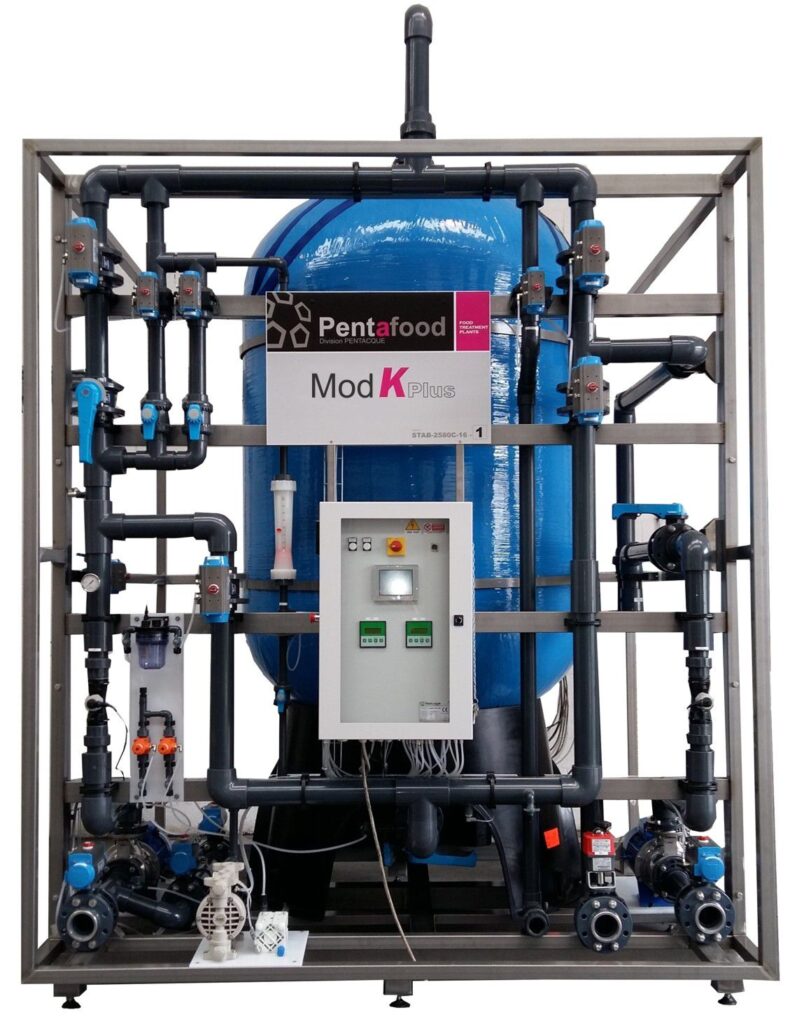
Technical configuration
Wine flows through one or more columns filled with a cation exchange resin. The resin captures cations such as K+ and Ca2+ and releases hydrogen ions (H+). Lower cation levels reduce tartrate salt formation and improve long-term stability.
The plant is mounted on a stainless-steel self-supporting frame. Wine is fed by a stainless-steel pump into the resin columns. Pneumatically actuated valves manage the flows to ensure controlled operation and hygienic compatibility.
Sizing inputs
- Wine type and tartaric instability level.
- Initial K+ and Ca2+ concentrations.
- Flow rate and campaign volumes.
- pH and total acidity constraints.
- Upstream filtration and colloidal load.
In many cases, treating only 5 to 25 percent of the wine and blending it back is sufficient to achieve overall stability while limiting pH and acidity changes.
FAQ
Wine passes through a cation exchange resin that removes mainly K+ and Ca2+. Lower cation levels reduce potassium bitartrate and calcium tartrate precipitation, improving tartaric stability.
It can decrease pH and increase total acidity because H+ is released during exchange. The magnitude is managed through process parameters.
Yes. The systems use food-grade certified resins and materials selected for wine compatibility.
Key inputs include flow rate, inlet analysis, outlet specification and production constraints.